Binance Hack of 29 October 2026
Published October 29, 2026· Updated November 1, 2026· By Juan Martinez
Billions left Binance on 29 October. It puts the damage at $6.3 billion, says the attack was more complex than first thought, and promises to repay all losses.
On 29 October 2026, billions of dollars moved out of Binance wallets. Binance paused withdrawals and promised to cover all losses. It first pointed to an engineer’s laptop, then said the attack was more complex than that. The same day, Polymarket, a site where people bet on real-world events, said a compromised outside provider caused a loss that outside analysts put at about $2.7 million.
This note reflects the afternoon of 1 November 2026 (UTC). Events are still unfolding, and we will update it.
Binance: withdrawals paused, investigation under way
At 20:24 UTC, a wallet labelled “Binance 14” on a blockchain explorer (a public site that shows every transaction) sent 167,464 ETH and 63 other kinds of tokens to a new address in one transaction. At 20:41 UTC, 780 million USDC left through the same route [7].
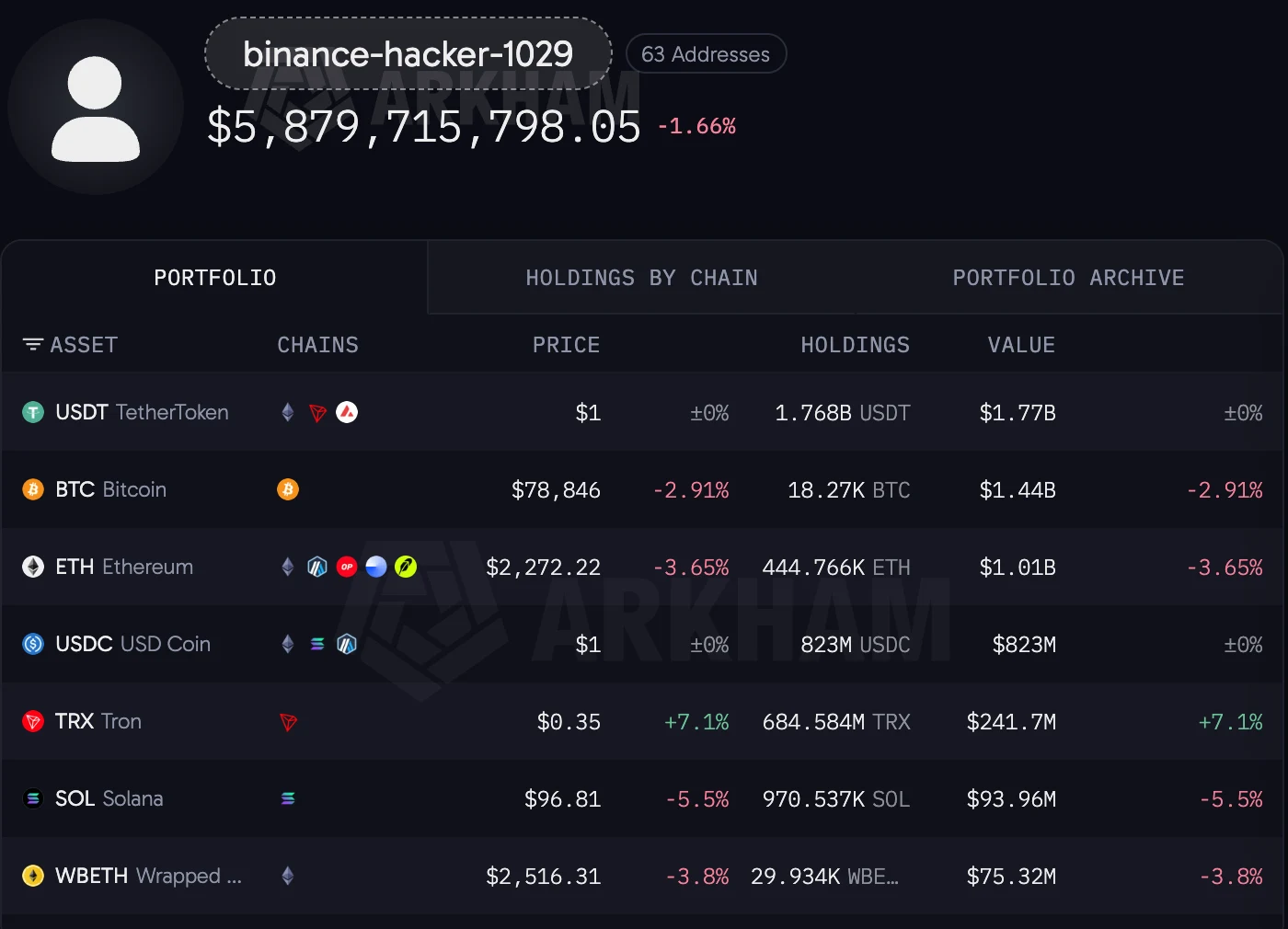
Binance’s own estimate of the total damage is around $6.3 billion [1]. Outside counts differ. Unchained counted about $3.52 billion on Ethereum alone [5]. The security company Blockaid is examining about $3.3 billion, and Conor Grogan of Coinbase puts it at up to $5.8 billion [6]. These counts overlap, so they cannot be added together. Arkham, a blockchain analytics site, lists 63 addresses labelled “binance-hacker-1029” that held about $5.88 billion at 23:08 UTC, including about $1.44 billion in bitcoin. Part of the USDT and USDC there is frozen, so this is not the net loss [11].
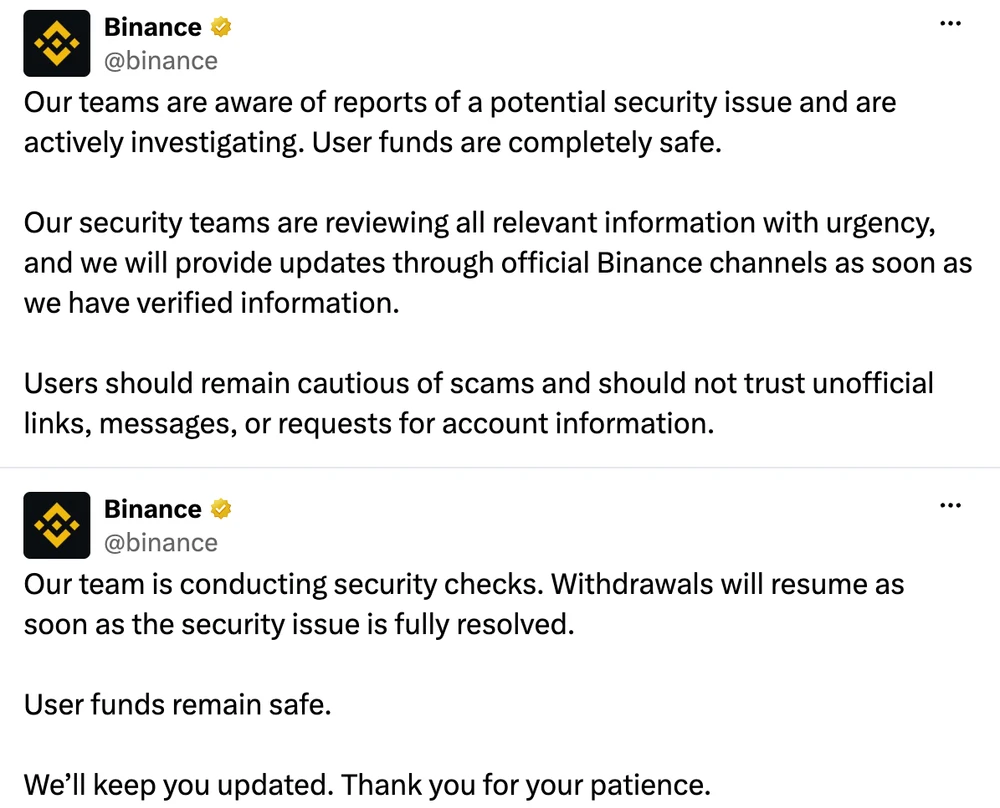
Binance’s first post on X said it was looking into “a potential security issue” and that user funds were safe. Later it said withdrawals were paused and would “resume as soon as the security issue is fully resolved” [1]. Yi He, a Binance co-founder, said they were “disabled until the environment is confirmed to be secure” [3].
Around 00:13 UTC on 30 October Binance said it “will cover all losses” and would publish a full report when the investigation is finished [1]. Yi He called them “hacking losses” [3]. Hours later Binance gave a first explanation: the attack may have started with a work laptop of one of its engineers, which let the attacker reach an internal system and send withdrawals. It said it had found no sign that the keys to its wallets leaked, and that it would pay from its SAFU fund and company money [1].
By the morning that explanation had changed. Binance wrote that its later investigation “has uncovered additional points of breach” and called it “a complex attack”. It said deposits were unaffected, that withdrawals should resume in about 45 hours, and that the outflows “ceased when we paused withdrawal service” [1]. These are Binance’s own findings, and no outside confirmation has been reported.
By midday Binance said it had set aside over $6.34 billion of its own money to repay users, and that $5 billion of it is already held in the same tokens that were taken. It is buying the rest on the market [1]. Yi He said the same: Binance is buying the stolen coins “in fully matching amounts” [3].
On the evening of 30 October, Binance published a longer update signed by its two co-CEOs. For the first time it uses the word itself: it says its hot wallets “were compromised” and calls the case “this complex hack”. It repeats that it has found no evidence that the keys to its wallets leaked. It said more technical findings would follow in about 48 hours [1].
On 31 October Binance said the share of the loss it has already made good is up to 90%, from 80%. Ten big coins, including bitcoin, ether, USDT and USDC, are covered in full. The last 10% is smaller, less traded coins, which take longer to buy. It is paying with part of its SAFU emergency fund, part of an insurance fund for futures trading and its own company money, and says it will refill SAFU to about $1 billion. It published a new Proof of Reserves snapshot, a public check that user balances are backed one to one; the full proof is due by Tuesday 3 November. On the morning of 1 November Binance started switching withdrawals back on, one network at a time, and says it will add the rest as its security checks are finished [1].
Some of the money is frozen. Binance says the verified total is around $3 billion and may keep rising [1]. Tether’s CEO, Paolo Ardoino, wrote that Tether froze more than 1.567 billion USDT “related to a potential Binance exchange hack”. Circle’s CEO, Jeremy Allaire, wrote that Circle froze more than 800 million USDC “associated with the incident” [2]. Binance co-founder Yi He thanked Ripple for freezing approximately 200 million and wrote that the Arbitrum Security Council froze about $30.5 million [3].
Changpeng Zhao (CZ) founded Binance and no longer runs it. 0xngmi, a developer at DeFiLlama, estimated the Binance loss after freezes at around $1 billion. Under that estimate CZ wrote: “Loss might be a bit higher than that, but will cover.” [2] This is not a statement from the company.
Outside analysts noticed a transaction four minutes before the transfers. It gave a contract controlled by the attacker power over the “Binance 14” wallet, which needs a valid approval from the wallet’s owner. At that point nobody knew how the attacker got it, and no explanation was proven [7]. Binance’s later explanation is its own finding.
Polymarket: a compromised provider, again
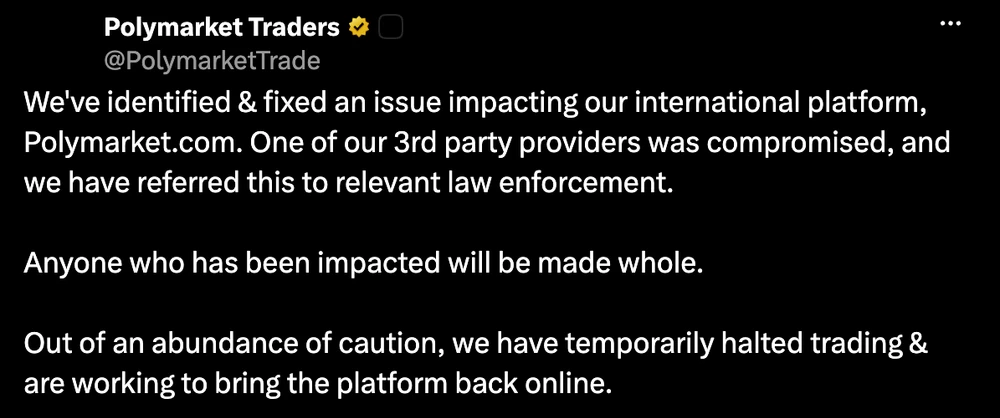
Polymarket posted on X: “One of our 3rd party providers was compromised, and we have referred this to relevant law enforcement. Anyone who has been impacted will be made whole.” It halted trading as a precaution. A later post said trading would resume at about 3 p.m. New York time, and then that it was “fully back online” and that affected traders are being fully reimbursed [4].
The company gave no loss figure. The same 0xngmi estimates about $2.7 million for Polymarket, and says the provider tracks website performance and ran scripts on Polymarket’s site [8] [13]. Polymarket has not named the provider or confirmed this.
On 30 October Polymarket began paying people back. It wrote that 689 of 726 affected wallets had been refunded in full and the other 37 would be paid as each is checked. It is also covering traders who lost money during the trading pause, $1.19 million to 5,500 wallets. In total it says it is returning $3.9 million, with “no claims or tickets needed”. It says it removed the provider within the hour and will publish a report [4].
In June 2026, a compromised outside supplier put a malicious script into Polymarket’s site, and about $3.1 million left 11 wallets, according to AMLBot [9]. The smart contracts that settle bets were not hacked [10].
What this means if your coins are on an exchange
At Polymarket, the way in was a provider whose code ran on the site, a kind of supply chain attack. At Binance, the company’s explanation has already changed once, and the full report is still to come.
On an exchange, the company holds the keys to your coins, not you. This is called key custody: what you own is a claim on the company. Our Coinbase review describes such a service. With self-custody you hold the keys yourself; our crypto wallets section reviews wallets of that kind.
Both companies promised to pay for the losses. Polymarket says it has already refunded most affected wallets [4]. Binance says it has set aside over $6.34 billion of its own money to repay users, but the final amount and the full report are still to come [1]. A promise is not a guarantee.
After news like this, scammers send messages about “refunds” and “account checks”. Binance’s own post warns users to be cautious of scams and not to trust unofficial links, messages or requests for account information [1]. Two habits help whatever you decide to do with your coins:
- Protect the account with two-factor authentication from one of the authenticator apps.
- Never type a seed phrase into any website. A seed phrase belongs only to a wallet you hold yourself, and an exchange account does not have one.
Summary
Billions moved out of Binance wallets on 29 October. Binance puts the damage at around $6.3 billion, says about $3 billion is frozen, and says it has set aside over $6.34 billion of its own money to repay all losses. It first pointed to an engineer’s laptop, then said the attack hit more than one point. On the evening of 30 October it called the case a hack for the first time. On 31 October it said 90% of the loss is already covered and that withdrawals started coming back on 1 November, one network at a time; deposits work. Polymarket said an outside provider was compromised and has already refunded most affected wallets. A promise to cover losses is not a guarantee, and coins on an exchange are held by the exchange.
Updates
- 29 October 2026, 23:14 UTC. Binance also suspended trading in its Binance Alpha section and wrote that it “will resume once the security issue is resolved” [1]. Paxos, the issuer of the PAXG gold token, said PAXG held on Binance “were moved to the suspected attacker’s address” and that it froze 1,906.67 PAXG. It says its own systems were not affected [12]. Ripple’s Jack McDonald wrote that Ripple is “actively freezing affected funds” in its RLUSD token, in a post quoted by CZ [2].
- 29 October 2026, 23:25 UTC. Binance gave its own figure for frozen funds: “the current verified total frozen is $2.54 billion”, adding that the figure “may continue to increase”. It said it was aware of other figures in circulation, “including references to $1.8 billion” [1]. This is the amount frozen, not the amount lost.
- 30 October 2026, about 00:13 UTC. Binance: “Binance will cover all losses”, deposits and withdrawals are suspended, a full post-mortem will follow [1]. Yi He called them “hacking losses” [3].
- 30 October 2026, about 00:52 UTC. Binance raised the verified frozen total to “around $3 billion” [1]. The Arbitrum Security Council froze about $30.5 million, Yi He wrote [3].
- 30 October 2026, about 02:25 UTC. Binance gave a first explanation: an engineer’s work laptop may be involved, with “no evidence of any wallet private key leak”. It put the estimated damage at around $6.3 billion, about $3 billion frozen, and said it will cover all losses from the SAFU fund and company funds and publish an updated Proof of Reserves and a full report [1]. Yi He: withdrawals will be enabled “as soon as the security scan is complete” [3].
- 30 October 2026, about 04:36 UTC. Binance: deposits are unaffected, withdrawals stay paused while the withdrawal system is rebuilt, expected back “within 48 hours”. “The incident stems from multiple factors”, and a full report on the root cause will follow [1]. Yi He wrote the same [3].
- 30 October 2026, about 08:47 UTC. Binance said its first explanation was incomplete: “our subsequent investigation has uncovered additional points of breach”. Withdrawals are expected back “in 45 hours”, “the outflows ceased when we paused withdrawal service”, and about $3 billion is frozen [1].
- 30 October 2026, about 10:55 UTC. Binance said it has set aside over $6.34 billion of company money, $5 billion of it already in the affected tokens, and is buying the rest. The $3 billion frozen is not included [1]. Yi He: Binance is buying the stolen tokens “in fully matching amounts” [3].
- 30 October 2026, about 14:37 UTC. Polymarket: 689 of 726 affected wallets are refunded in full, the other 37 are being paid as each is checked. It also covers $1.19 million of losses from the trading pause, so the total returned is $3.9 million. It removed the provider within the hour and will share a report [4].
- 30 October 2026, about 19:58 UTC. Binance published a longer update signed by its co-CEOs. It says its hot wallets “were compromised” at about 20:05 UTC on 29 October, calls the case “this complex hack” and puts the loss at about $6.3 billion. “We have found no evidence that wallet private keys were leaked.” Binance says it covers about 80% of the loss with tokens already held and is buying the remaining 20%. Withdrawals should start coming back in phases within about 34 hours. A Proof of Reserves snapshot is planned in 12 hours, with the result by Monday 2 November, and more technical findings in about 48 hours [1].
- 31 October 2026, about 14:30 UTC. Binance, Update #3: the covered share of the loss is up to 90%. Bitcoin, ether, USDT, BNB, SOL, USDC, XRP, USD1, RLUSD and ZEC are “fully backed 100%”; the remaining 10% is in smaller tokens. It uses part of SAFU, part of its futures insurance fund and company money, and will refill SAFU to about $1 billion. A new Proof of Reserves snapshot is published, the full proof is due by Tuesday 3 November. Withdrawals are “on track” to reopen on Sunday 1 November. A separate post confirms the SAFU transfer of 7,499 BTC is complete [1].
- 1 November 2026, from about 10:03 UTC. Binance began switching withdrawals back on, one network at a time: first bitcoin, ether, USDT, USDC, BNB, XRP and DOGE on the biggest networks, then Arbitrum, TRON, Solana, Polygon and Avalanche, and by midday also ZEC, TON and SUI. It says the rest will return “in phases as security checks are completed” [1]. A report on the cause and a final loss figure have not been published yet.